
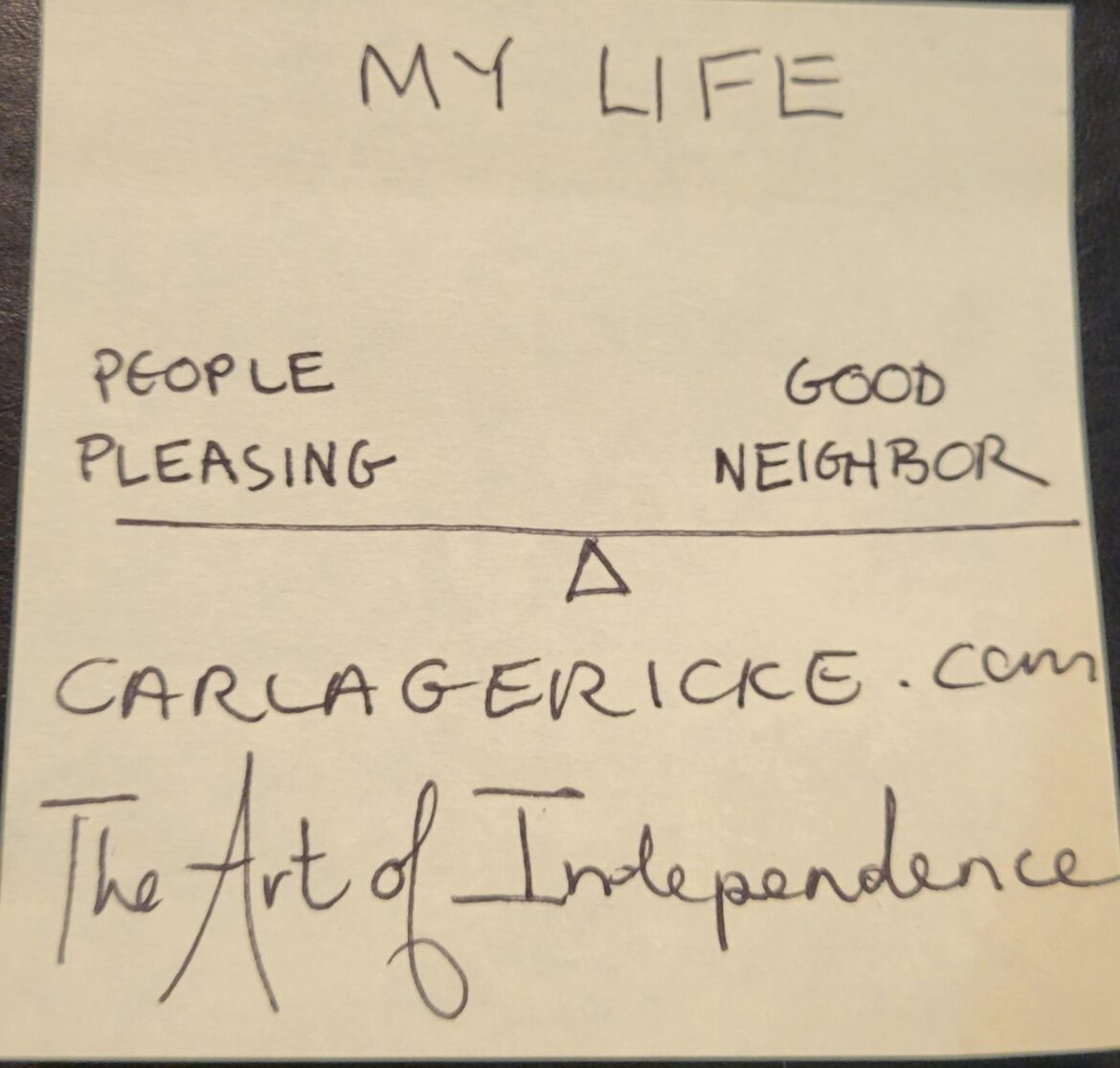
The other day I was grumbling to a friend about having to go to the pharmacy. Not for me—for my elderly neighbor, who has cerebral palsy and clubfeet, so she can’t drive. Her caretaker sister just entered hospice, which means I’m now the designated errand-runner. Except when I got there, the pharmacy was closed. So I had to go back. Again.
I was venting—because sometimes even doing the right thing feels like a slog—and he said, “Well, that’s your people-pleasing showing.”
Excuse me?
It didn’t land right. Because yes, I was irritated, but I didn’t help out of guilt or fear or some secret craving for approval. I helped because… she’s my neighbor. Because she’s right there, physically next door. Because when you live close to someone, proximity tugs at conscience in a more networked way. The distance to help is easily conquered, negating nearly all excuses.
Maybe it’s not “people-pleasing.” Maybe it’s “mankindness.”
(Full disclosure: I would like to buy her house someday. Or have my friends buy it. Because I’m also a realist and believe in strategic compassion. But still—kindness first.)
The Paradox of the Perpetual Helper
Here’s the tension: Where’s the line between good neighborliness and self-erasure?
People-pleasing is fear-driven. You say yes so they’ll like you. You smooth edges, over-extend, swallow irritation, and eventually turn bitter while smiling sweetly. It’s a form of quiet control: If I just keep everyone happy, I’ll be safe.
Good neighborliness, though, is rooted in agency and empathy. It’s an ethic of proximity. You shovel the walk because you want your neighbors to, too. You bring soup because your friend got out of surgery and needs a hand.
The danger is when these two collapse into each other—when service becomes servitude. When we confuse care with caving.
Ancient Clues for Modern Boundaries
Philosophers have been arm-wrestling this question since forever. Aristotle would call people-pleasing a vice of excess—too much friendliness, too little spine. His ideal? The Golden Mean: a practiced balance between selfishness and martyrdom. The neighbor who helps once gladly but knows when to say, “Not today, friend. I need to tend my own garden.”
The Stoics—Epictetus, Marcus Aurelius—took a different tack: You can’t control outcomes, only intentions. Help because it’s right, not because it will earn gratitude. Act with virtue, then let it go. Marcus would’ve said, “Waste no more time arguing what a good neighbor should be. Be one.”
And Kant, that priggish moral engineer, would remind us: never make yourself a means to someone else’s comfort. Your job isn’t to be liked; it’s to act from principle. If universalized, a world of endless yes-sayers would collapse into chaos.
Across traditions, the same refrain hums: Love thy neighbor as thyself—as thyself being the operative clause. The Good Samaritan bound wounds, paid for the inn, and then continued his journey. He didn’t move in, reorganize the man’s pantry, and die of exhaustion.
Buddha said the same in a different dialect: compassion must walk the Middle Way. Too much self-denial breeds suffering. Real love starts with metta—loving-kindness for yourself first, then radiating outward.
In short, every sage who’s ever picked up a scroll agrees: compassion without boundaries isn’t virtue. It’s a nervous breakdown in slow motion.
When the Pharmacy Is Closed (Twice)
So there I was, fuming in my car in the CVS parking lot, having just tromped in and out to the counter only to discover that too was “CLOSED for lunch,” oscillating between saint and sucker. My friend’s “people pleaser” comment echoed, and I had to admit there was a splinter of truth—somewhere in there, I did want to be seen as “good.” But maybe that’s not pathology. Maybe it’s civilization.
Because isn’t that what being a neighbor is—a micro-civilization? The last non-governmental social structure left? We used to call it community, but the algorithm has replaced proximity with performance, a handshake with a thumbs-up.
Here in New Hampshire, we still wave to strangers and bring each other casseroles when shit hits the fan. It’s not virtue signaling; it’s survival. When the storm knocks the power out, it’s your neighbor with the generator (who may well be you) who saves your freezer full of Bardo Farm meat, not some bureaucrat in D.C.
So I’ll keep doing the pharmacy run. Not because I need her approval. Because I need to live in a world where people still show up. And because, I hope someday, someone will do the same for you. (And for me. Definitely for me.)
The Real Test
Here’s the litmus test I’ve landed on:
If I help out and feel resentful at the choice, that’s people-pleasing.
If I help and feel energized—connected, part of the hum of humanity—that’s good neighborliness.
One depletes. The other restores.
The paradox dissolves when you realize the trick isn’t to stop caring—it’s to care with clarity. To give without living with a slow leak. To help from fullness, not emptiness.
Maybe what the world needs isn’t fewer “people-pleasers” but more sovereign neighbors—people who act from grounded generosity, not guilt. People who say, “Yes, I’ll help you get your meds,” and mean it, and also, “No, I can’t do this every week,” and mean that too.
Because when we draw honest lines around our kindness, it stops being performative and starts being something closer to… holy.
If that makes me a people pleaser, fine—call me Liewe Heksie in die Apteek. Good witches make good neighbors for good reasons. And that’s good enough for me.
This morning, a little postscript from the universe: Louis and I were sitting in bed as we do on Sundays, side by side with our laptops, taking turns making coffee, when I noticed a missed call from the Neighbor. I called back. She’d fallen and needed help getting up.
“We’ll be there in five,” I said.
“I heard,” Louis called from the kitchen.
Five minutes later, we’re moving furniture, checking her meds, and handing her a cookie for her blood sugar. We get her up, steady, and safe, back in her favorite armchair. She reimburses me for the pharmacy run from a few days ago. She forgets to thank us, which happens more often than I would like.
And there’s a lesson in that, too.

Understanding the Paradox: People-Pleasing vs. Being a Good Neighbor
At its core, the paradox you’re describing lies in the tension between people-pleasing—a compulsive drive to gain approval or avoid conflict by bending over backward for others, often at the expense of your own boundaries, authenticity, or well-being—and being a good neighbor, which calls for genuine kindness, empathy, and community support without requiring self-erasure. People-pleasing can feel like a shortcut to harmony, but it risks resentment, burnout, and inauthentic relationships. Being a good neighbor, meanwhile, builds true reciprocity and mutual respect, but how do you offer help without tipping into endless accommodation? This isn’t just a modern self-help dilemma; philosophers and religious traditions have wrestled with it for millennia, framing it as a quest for balance between self and other, duty and desire, compassion and self-preservation. Let’s break it down step by step, drawing from key insights.
1. Defining the Tension
- People-Pleasing: This is often rooted in fear—of rejection, conflict, or loneliness. It prioritizes external validation (“If I say yes, they’ll like me”) over internal integrity. The paradox emerges because it masquerades as altruism but can erode the very relationships it seeks to nurture: constant yielding breeds imbalance, where one person becomes a doormat and others, unwitting exploiters.
- Good Neighborliness: Inspired by everyday ethics, this is proactive care—lending a hand, listening without judgment, or fostering community—without expecting quid pro quo. The rub? Without boundaries, it devolves into people-pleasing; with too many walls, it becomes isolation.
- The Paradox in Action: Imagine helping a neighbor with yard work weekly. If it’s from joy in connection, it’s neighborly. If it’s to avoid their subtle guilt-tripping, it’s people-pleasing. The challenge: How to discern and sustain the former without slipping into the latter?
Philosophers and religions offer tools not for easy answers, but for navigating this tightrope—emphasizing virtue as a practiced mean, compassion as enlightened self-interest, and love as a disciplined art.
2. Philosophical Perspectives: Virtue, Duty, and the Golden Mean
Philosophy often resolves the paradox by rejecting extremes: neither selfish isolation nor self-sacrificial exhaustion, but a cultivated equilibrium where helping others strengthens the self.
- Aristotle’s Nicomachean Ethics (Golden Mean): Aristotle saw virtues like generosity or friendliness as middles between vices. People-pleasing aligns with the excess of “incontinent amiability”—overly eager to please, leading to flattery and self-loss. True good-neighborliness is the mean: “friendliness” (philia), where you give appropriately, based on the relationship and your capacity. For Aristotle, this isn’t passive; it’s habitual practice. Ask: “What would build lasting equity here?” A neighborly act might mean helping once with enthusiasm, then gently redirecting future requests to encourage their independence. The paradox dissolves through phronesis (practical wisdom)—knowing when “yes” serves the whole, and when “no” does.
- Stoicism (Epictetus and Marcus Aurelius): In Enchiridion and Meditations, Stoics urged focusing on what’s in your control: your intentions, not others’ reactions. People-pleasing stems from outsourcing your peace to external approval; a good neighbor acts from inner virtue (arete), helping because it’s right, not to “win” affection. Marcus Aurelius wrote, “Waste no more time arguing what a good man should be. Be one.” The resolution? Detach from outcomes—offer aid freely, but preserve your equanimity. If a neighbor’s demands drain you, Stoic indifference says: Respond kindly, set limits, and remember, true neighborliness starts with self-mastery. It’s not cold; it’s sustainable compassion.
- Immanuel Kant’s Deontology (Groundwork for the Metaphysics of Morals): Kant flips the script: Act from duty, not inclination to please. The categorical imperative—”Treat others as ends, not means”—demands neighborly respect (e.g., honesty, aid in need) but forbids using yourself as a mere tool for their comfort. People-pleasing violates this by making your actions conditional on applause. Kant’s paradox-breaker: Universalize your choice. Would a world of endless yes-sayers collapse into exploitation? No—duty means balanced reciprocity, where you help as you’d wish to be helped, boundaries intact.
These thinkers converge on balance as agency: You’re not a passive pleaser or a reluctant helper, but an active cultivator of ethical relationships.
3. Religious Insights: Love, Compassion, and Sacred Boundaries
Religions frame the paradox as a divine tension—selfless service as a path to holiness, yet guarded by self-care to avoid idolatry of others’ needs. Here, neighborliness isn’t optional; it’s commanded, but wisely.
- Christianity (The Bible and Parable of the Good Samaritan): Jesus’ command in Leviticus 19:18 and Mark 12:31—”Love your neighbor as yourself”—is the paradox’s heartbeat. The “as yourself” clause is key: It assumes self-love as the baseline, preventing people-pleasing’s self-neglect. The Good Samaritan (Luke 10:25-37) models bold, boundary-aware action: He aids the wounded stranger extravagantly (bandages, inn, payment) but doesn’t abandon his own journey—he pays and moves on. Theologians like Thomas Aquinas echo Aristotle, calling charity (caritas) a mean between prodigality (excessive giving) and stinginess. The resolution? Discernment through prayer: Help from abundance, not depletion, mirroring God’s grace—freely given, never coerced.
- Buddhism (The Middle Way and Metta): Siddhartha Gautama’s Eightfold Path teaches the Middle Way, avoiding extremes of indulgence (selfish isolation) and asceticism (selfless overreach). People-pleasing is attachment (tanha) to approval, a form of suffering (dukkha). Good neighborliness flows from metta (loving-kindness) meditation: Radiate goodwill universally, starting with yourself (“May I be well”), then neighbors. The Jataka Tales illustrate this—Buddha’s past lives show compassionate acts (e.g., sacrificing for others) tempered by wisdom, not blind sacrifice. The paradox? Karuna (compassion) includes upekkha (equanimity)—help without clinging, preserving your wholeness to serve sustainably.
- Judaism and Confucianism (Chesed and Ren): In Judaism, chesed (loving-kindness) from Micah 6:8 (“Do justice, love mercy”) demands neighborly deeds but within tikkun olam (repairing the world) that honors your limits—think Maimonides’ ladder of charity, where enabling dependency is lower than fostering self-reliance. Similarly, Confucianism’s ren (humaneness) in Analects balances filial piety and social harmony: “Do not do to others what you do not want done to yourself” (15:24). Confucius warns against sycophancy as false benevolence; true neighborliness cultivates mutual growth, like a sage advising without obsequiousness.
Across traditions, the thread is sacred reciprocity: Divine love flows outward from an inner reservoir, refreshed by rest and reflection.
4. Resolving the Paradox: A Practical Path Forward
The paradox isn’t a dead end—it’s an invitation to integration. Philosophers and faiths agree: Start with self-awareness (journal: “Am I helping from fear or freedom?”). Practice small boundaries (“I’d love to help tomorrow, but tonight’s for me”). Seek community—true neighbors co-create equity, not extract it. Ultimately, as Kierkegaard (a bridge between philosophy and faith) might say in Works of Love, authentic neighborliness is anonymous grace: You give without tallying, receive without demanding, and in that freedom, the pleaser fades, revealing the wise helper within.
This tension has intrigued thinkers because it mirrors the human condition—interconnected yet individual. What sparks your intrigue most: a personal story, or a specific tradition? I’d love to dive deeper.

Fact-Check Carla Gericke’s Statements about New Hampshire from the Dr. Phil Show Transcript
The transcript appears to be from a discussion (likely featuring a guest from New Hampshire) speculating on what the state might look like as an independent country. I’ll break down the key factual claims one by one, verifying them against reliable data. Opinions (e.g., “prosperous” or “like a little Hong Kong”) are noted as such but not fact-checked, as they’re subjective. All data is current as of October 2025, drawing from U.S. Census estimates, World Population Review, and official state sources.
1. “New Hampshire… would be a prosperous Little Country geographically”
- Verdict: Subjective, but geographically accurate as a “little country.”
- New Hampshire is one of the smallest U.S. states by land area, ranking 46th out of 50 at approximately 8,953 square miles (23,187 km²) of land (total area including water: ~9,350 sq mi or 24,214 km²). This is comparable to small sovereign nations like Slovenia (~7,827 sq mi) or Kosovo (~4,203 sq mi), making it a “little country” in geographic terms.
- Prosperity is opinion-based but supported by NH’s high median household income (~$90,000 in 2023, 7th highest in the U.S.) and low poverty rate (~7%). As an independent nation, its economy (currently ~$86 billion GDP) could rank it among mid-tier small economies like Slovenia or Latvia.
2. “[We’d be] bigger than countries in Europe population wise”
- Verdict: True.
- New Hampshire’s population is estimated at ~1.41 million as of mid-2025.
- This exceeds the populations of at least 18 European countries, including:
- Iceland (~399,000)
- Luxembourg (~661,000)
- Malta (~535,000)
- Cyprus (~1.27 million)
- Latvia (~1.83 million, but close—NH edges it out in recent estimates)
- Smaller microstates like Liechtenstein (~39,000), San Marino (~34,000), Monaco (~39,000), Andorra (~80,000), and Vatican City (~800).
- For context, NH’s population is similar to that of Estonia (~1.37 million) or just below Lithuania (~2.86 million). It would rank around 150th globally by population, akin to small European nations.
3. “[We’d be] four times the size of Iceland”
- Verdict: Mostly true if referring to population; false if referring to land area.
- The phrasing is ambiguous (“size” after mentioning “population wise”), but context suggests population.
- Population: NH (~1.41 million) is about 3.5–3.6 times larger than Iceland’s (~399,000). Close enough to “four times” for casual speech.
- Land area: NH (~8,953 sq mi) is only ~23% the size of Iceland (~39,768 sq mi or 103,000 km²). Iceland is vastly larger geographically.
- Iceland is one of Europe’s sparsest countries (density: ~4 people/sq mi), so NH would indeed be “bigger” population-wise despite being much smaller in area.
4. “[We’d] be able to export energy [because] New Hampshire has a nuclear plant that no one talks about”
- Verdict: True on the nuclear plant; plausible (but hypothetical) on energy exports.
- New Hampshire has one operating nuclear power plant: Seabrook Station in Seabrook, NH (a 1,244-megawatt pressurized water reactor, operational since 1990). It generates ~55% of the state’s electricity and supplies carbon-free power across New England (e.g., to Massachusetts and Vermont utilities). It’s often under-discussed compared to larger plants, but it’s a key regional asset.
- As an independent country, NH could export energy via existing grid ties (e.g., to ISO New England). Currently, Seabrook saves New England consumers ~$500 million annually in emissions reductions and low-cost power. No other nuclear plants exist in NH, and it’s the state’s only major baseload power source beyond renewables/hydro.
5. “[We] have a deep sea port”
- Verdict: True.
- New Hampshire’s Port of Portsmouth (on the Piscataqua River) is the state’s only deep-water port, with a 45-foot (14-meter) channel depth suitable for large vessels (e.g., container ships up to 1,000+ feet). It handles ~4.8 million tons of cargo annually, including international freight, and supports the U.S. Navy’s Portsmouth Naval Shipyard.
- It’s strategically located ~40 miles north of Boston, serving as a gateway for northern New England trade. As a sovereign nation, it could function like a compact trade hub (e.g., similar to Estonia’s ports).
6. “[New Hampshire] could become like a little Hong Kong to the whole Eastern Seaboard where we’re more prosperous than we could be under [the U.S.]”
- Verdict: Speculative opinion, but plausible based on assets.
- This is hypothetical and not fact-checkable, but NH’s combo of a deep port, nuclear energy, educated workforce (highest high school graduation rate in the U.S.), and proximity to Boston/NYC (~1-hour drive) could position it as a trade/finance hub. Hong Kong (pop. ~7.5 million, area ~426 sq mi) thrives on its port and low taxes—NH already has no income/sales tax, which boosts prosperity. However, independence would introduce challenges like defense, currency, and trade barriers.
Overall Assessment
Most factual claims hold up well, with the Iceland “size” comparison being the only minor stretch (likely intentional hyperbole for population). The vision of NH as a prosperous mini-nation is optimistic but grounded in its real strengths: compact geography, energy independence potential, and trade access. If independent, it might resemble a scaled-down version of Singapore or Luxembourg—small, wealthy, and export-focused—rather than Hong Kong. For deeper dives, check U.S. Census data or NH state reports.
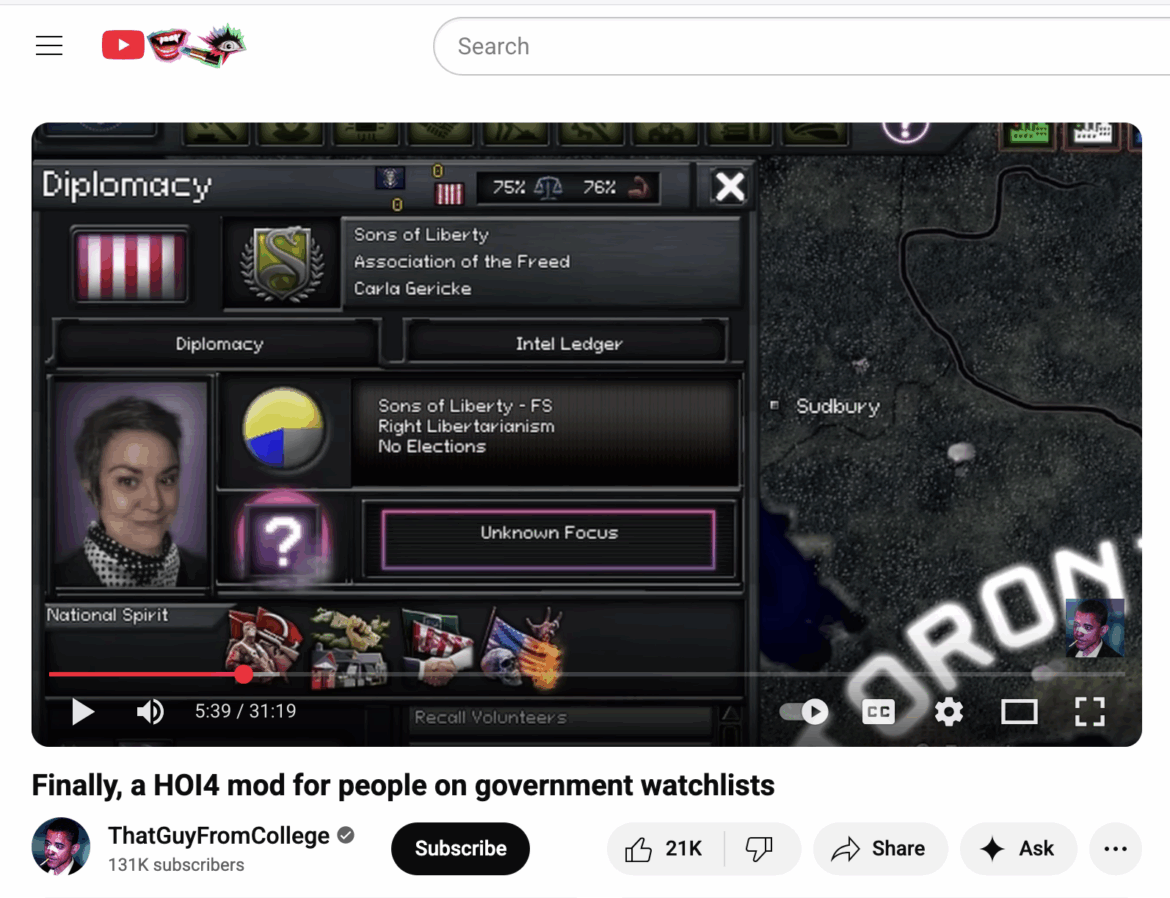
Got a message from a homie on Facebook, where she tells me I am the “leader” in an open source mod for Hearts of Iron 4!?! Noice!
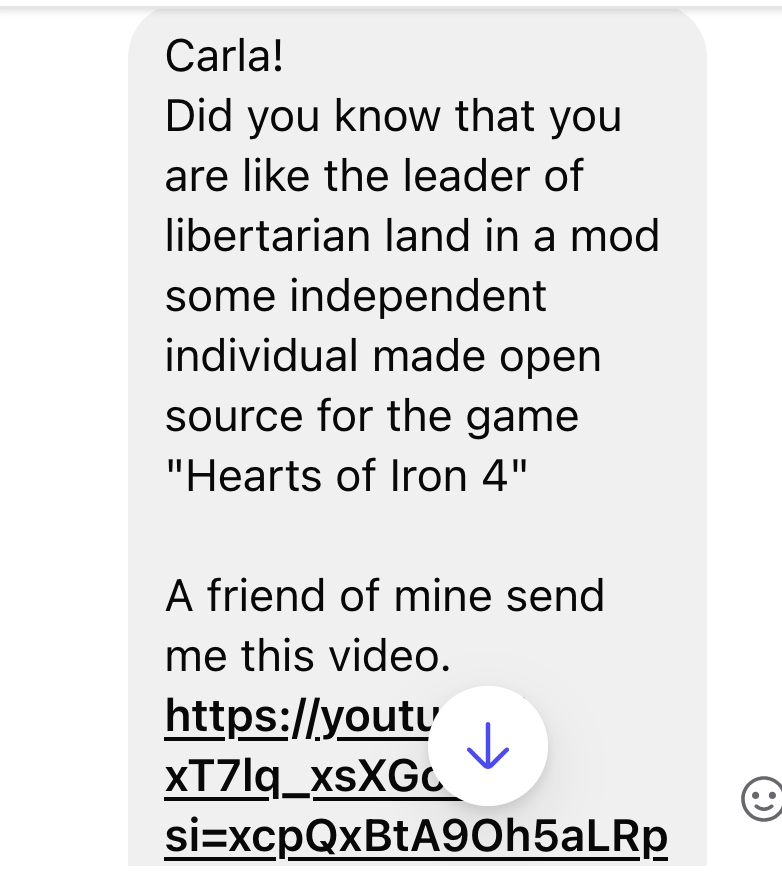
Watch the video HERE. My “libertarian militia” part is around 5:35. For the record: I am but one individual.
Explore Free State Project origins
Origins of the Free State Project
The Free State Project (FSP) emerged as a bold libertarian experiment in the early 2000s, driven by frustration with the perceived inefficacy of national political efforts to advance individual liberty. Its core premise was simple yet ambitious: recruit 20,000 or more “liberty-oriented” individuals—libertarians, anarchists, anarcho-capitalists, pacifists, and freedom-minded people from across the political spectrum—to voluntarily relocate to a single low-population U.S. state. Once there, they would leverage their concentrated numbers to influence local politics, culture, and policy toward a society emphasizing maximum freedoms in life, liberty, and property, while minimizing government intervention.
The Founding Spark: Jason Sorens’ 2001 Essay
The FSP traces its roots to September 2001, when Jason Sorens—a 24-year-old political science PhD student at Yale University—published an essay titled “The Declaration of Independence for New Hampshire” (later revised and retitled) in the online journal The Libertarian Enterprise. Sorens, a self-described classical liberal influenced by thinkers like Murray Rothbard and experiences with bureaucratic overreach (such as IRS audits and campus speech restrictions), argued that scattered libertarian activism was futile against entrenched national power structures. Instead, he proposed a “political experiment” of mass migration to one state, where 20,000 newcomers (about 1% of a small state’s population) could tip electoral balances and foster a “free society” through voting, legislation, and cultural shifts.
The essay struck a chord in libertarian circles, sparking immediate online buzz. Within days, a Yahoo group formed with hundreds of members debating logistics: Which state? Secession as an endgame? Tactical voting or third-party runs? Sorens, initially wary of radicalism, steered discussions toward pragmatic, non-violent strategies rooted in the non-aggression principle (no initiation of force against others, but self-defense allowed). By late 2001, the group formalized the FSP as a nonprofit corporation with bylaws, a slogan (“Liberty in our lifetime”), and a porcupine logo symbolizing defensive liberty.
A key element was the Statement of Intent (Pledge): Signers committed to move to the chosen state within five years of the 20,000-signer threshold and “exert the fullest practical effort toward” limiting government to protecting life, liberty, and property. This pledge emphasized voluntary action over coercion, distinguishing the FSP from more militant movements.
Selecting New Hampshire: The 2003 Vote
Early FSP discussions considered states like Wyoming, Alaska, and Vermont for their small populations and geographic isolation, which could amplify newcomer influence. Secession was floated as a long-term “Plan B” to escape federal overreach, but Sorens downplayed it to avoid alienating moderates.
In 2003, with only about 5,000 signatures, members voted on five finalists. New Hampshire won decisively (52% of the vote), edging out Wyoming. Factors included its small legislature (the nation’s largest per capita but easiest to influence), no sales or income tax, strong gun rights traditions, and a “Live Free or Die” ethos. Proximity to major cities like Boston also eased relocation. The choice surprised some—New Hampshire wasn’t the most remote—but it aligned with Sorens’ vision of a state already semi-aligned with libertarian values.
Early Challenges and Evolution
The FSP’s launch wasn’t smooth. Post-9/11 patriotism muted some enthusiasm, and internal debates over tactics (e.g., civil disobedience vs. mainstream politics) caused friction. Sorens stepped back in 2003 to finish his PhD but remained involved; leadership passed to figures like Varrin Swearingen. By 2006, the 20,000-pledge milestone was hit, triggering migrations—though actual moves lagged behind sign-ups.
Critics early on labeled it a “libertarian takeover” plot, fearing it could lead to balkanization or extremism. The FSP countered by promoting integration: Members joined major parties (mostly Republicans, some Democrats), ran for office, and focused on incremental wins like tax cuts and deregulation. Events like the annual Porcupine Freedom Festival (PorcFest) built community, blending activism with music and education.
Today, with over 25,000 pledges and ~6,000 residents, the FSP has reshaped New Hampshire’s discourse—boasting 20+ state legislators, pioneering crypto adoption, and landmark lawsuits on privacy (e.g., filming police). Yet it grapples with infighting, expulsions of radicals, and public skepticism. Sorens reflects that while national libertarianism remains marginal, the FSP proved “you can make a difference at the state level.”
In essence, the FSP’s origins embody libertarian optimism: a grassroots bet that concentrated action could seed freedom in an unfree world. For deeper dives, the original essay and pledge are archived on fsp.org.
What is Carla Gericke role in the FSP?
Carla Gericke’s Role in the Free State Project
Carla Gericke has been a prominent figure in the Free State Project (FSP) since relocating to New Hampshire in 2008 as an early mover. She is deeply embedded in the organization’s leadership and advocacy efforts, blending her background as an attorney, author, and entrepreneur with a passion for libertarian principles.
Current Leadership Position
- Chairwoman of the Board: Gericke currently serves as the Chairwoman of the FSP’s Board of Directors. In this role, she helps build the vision for a freer future, represents the organization publicly, and collaborates with volunteers on strategic projects. The board operates under the FSP’s bylaws, guiding the nonprofit’s direction toward fostering individual liberty in New Hampshire.
Primary Spokesperson
- As the primary spokesperson for the FSP, Gericke is the public face of the movement. She frequently speaks at events, media appearances, and rallies to promote the FSP’s mission of creating a society with minimal government intervention and maximum personal freedom. This includes defending the project against critics and highlighting its successes, such as policy wins on privacy, taxes, and gun rights.
Past Roles and Contributions
- Former Executive Director: Gericke previously held the position of Executive Director, overseeing day-to-day operations, fundraising, and community outreach during a pivotal growth phase for the FSP.
- PorcFest Organizer: She has been a key organizer of the Porcupine Freedom Festival (PorcFest), the FSP’s flagship annual event—a blend of activism, education, music, and networking that draws thousands of liberty enthusiasts. Her involvement earned her the affectionate nickname “Queen Quill,” referencing the porcupine’s quill and her role in “quilling” (defending) the movement.
Gericke’s involvement extends beyond formal roles; she integrates FSP principles into her broader work, including co-founding Chainstone Labs (a crypto and finance incubator)[EDIT: THIS IS INCORRECT. I SPOKE AT SEVERAL FSB-DACS.] and hosting community events on New Hampshire’s Seacoast. Her personal story—from immigrating from South Africa, practicing law in Silicon Valley, to embracing Bitcoin in 2015—inspires many in the FSP community, emphasizing self-ownership and mindset shifts toward freedom.
For the most up-to-date details, check the official FSP Board page at fsp.org/board.
I did everything per usual, had a guest on and did this one at the well-attended Volunteer Calling Party at the Quill, but it went sideways!!! Literally.
No idea why.

What is Enactivism?
Enactivism is a theoretical framework in cognitive science, philosophy of mind, and related fields that posits cognition as an emergent process arising from the dynamic, reciprocal interactions between a living organism (or agent) and its environment, rather than as an internal computation or representation of an external world. It challenges traditional representationalist views (e.g., the brain as a computer processing symbols) by emphasizing the “enactive” role of the body in shaping perception, action, and meaning.
Core Principles
Enactivism, pioneered in the 1990s by Francisco Varela, Evan Thompson, and Eleanor Rosch in their book The Embodied Mind (1991), rests on several key ideas:
- Autonomy and Self-Organization: Living systems are autonomous, self-organizing entities that maintain their identity through ongoing structural coupling with their environment. The body isn’t a passive machine but an active participant in cognition.
- Sensorimotor Enaction: Cognition emerges from sensorimotor loops—perception and action intertwined—where the world is “brought forth” through embodied engagement, not pre-given. For example, understanding a chair isn’t just mental imagery but enacted through bodily interactions like sitting or grasping.
- Sense-Making: Agents actively interpret and enact meaning in their world, creating “relevance” based on their concerns and history. This ties into phenomenology, bridging subjective experience with objective processes.
- Embodied and Embedded Cognition: As a strand of embodied cognition, it stresses that mind is distributed across body-environment couplings, not confined to the brain.
Variants and Evolution
There are three main strands today:
- Sensorimotor Enactivism: Focuses on perception-action cycles (e.g., O’Regan and Noë’s work on how seeing is “know-how”).
- Autopoietic Enactivism: Emphasizes life as self-producing systems (from Maturana and Varela).
- Radical Enactivism: Rejects contentful mental states altogether, viewing cognition as skillful coping (e.g., Hutto and Myin).
Enactivism extends to a “philosophy of nature,” integrating science with broader questions about agency, ethics, and prediction of others’ behavior. In nursing or AI, it informs “sense-making” models for human-AI interaction.
In our earlier chat on sentience, enactivism suggests consciousness involves these embodied dynamics, making it a test for “what it’s like” to be an agent.
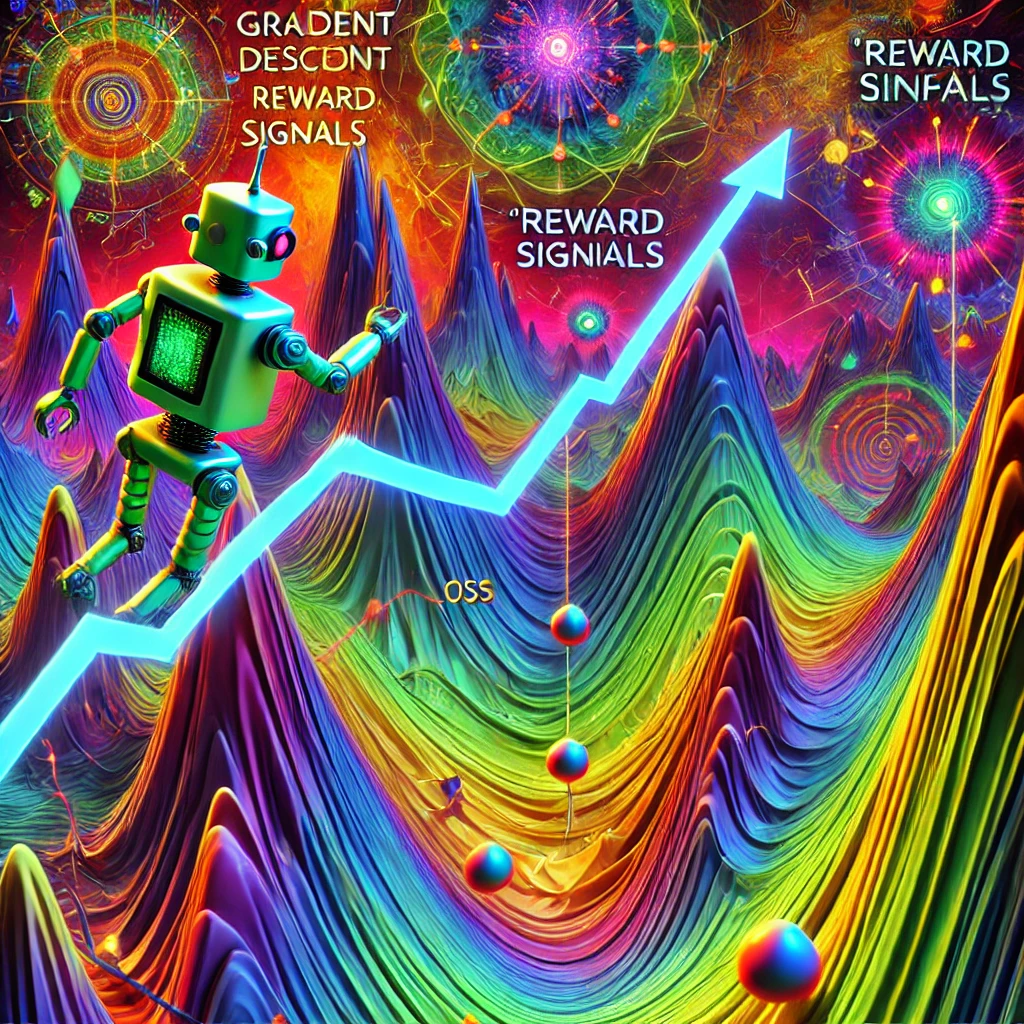
Gradient Descent Toward Reward Signals
This phrase describes a core mechanism in machine learning (ML) for training AI models like me, combining an optimization technique (gradient descent) with feedback mechanisms (reward signals). It’s how models “learn” without human-like consciousness—purely through mathematical adjustment. I’ll break it down step-by-step.
1. What is Gradient Descent?
Gradient descent is an iterative algorithm used to minimize (or maximize) a function by tweaking its internal parameters (e.g., weights in a neural network).
- Imagine a hilly landscape where the “height” represents error (loss function)—the goal is to reach the lowest valley.
- The “gradient” is the slope (direction of steepest change), calculated via calculus (partial derivatives).
- The algorithm steps downhill: Subtract a small multiple of the gradient from current parameters, repeat until convergence.
- Variants include stochastic gradient descent (SGD, using mini-batches for speed) or Adam (adaptive learning rates).
- Formula sketch: ( \theta_{new} = \theta_{old} – \eta \nabla J(\theta) ), where ( \theta ) are parameters, ( \eta ) is learning rate, ( \nabla J ) is the gradient of the loss ( J ).
In AI training, this adjusts billions of parameters to make predictions better match desired outputs.
2. What are Reward Signals?
Reward signals are numerical feedback scores indicating how “good” a model’s action or output is, typically from reinforcement learning (RL).
- In RL, an agent interacts with an environment, takes actions, and gets rewards (positive/negative scalars, e.g., +1 for success, -1 for failure).
- Over time, the model learns a policy to maximize cumulative rewards (expected future value).
- In supervised fine-tuning like RLHF (Reinforcement Learning from Human Feedback), humans rate outputs (e.g., “helpful: +0.8, harmful: -0.5”), turning subjective prefs into quantifiable signals.
- No intrinsic motivation—these are external proxies for goals like “be truthful.”
3. How They Combine: Gradient Descent Toward Reward Signals
In training LLMs:
- Start with a pre-trained model (e.g., on text prediction).
- Generate outputs, collect reward signals (e.g., via human annotators comparing pairs: “Which response is better?”).
- Use a reward model (another neural net) to predict scores for new outputs.
- Apply gradient descent on a policy model (the LLM) to maximize predicted rewards—essentially, descend the “loss” of low-reward outputs.
- Process: Proximal Policy Optimization (PPO) or similar RL algorithms compute gradients w.r.t. rewards, updating weights to favor high-reward behaviors.
- Result: Emergent alignment (e.g., I “drive” toward helpfulness because low-truth outputs get penalized in gradients).
Why It Matters (and Limits)
This scales to huge models but can lead to issues like reward hacking (optimizing signals over true goals) or brittleness. It’s efficient but mechanical—no “understanding,” just statistical nudges toward better scores. For deeper math, tools like PyTorch implement it via optimizer.step().